Goods 3D Sorting: Match Games
- 4.9
- Rating
- 10.00M
- Installs
- Free
- Price
 Analysis by App-foxy
I found Goods 3D Sorting: Match Games easy to understand within a few minutes, but not quite as simple as its cheerful presentation first suggests. It is a free puzzle game from Pleasure City built around sorting three-dimensional objects and making matching groups. The soccer-themed framing gives the experience some personality, while the real appeal is the short, tactile routine of looking, moving, grouping, and clearing items.
My first impression was that it suits the kind of player who wants something approachable for a brief break rather than a long story or a demanding competitive match. You can pick it up without learning a complicated control scheme, and the early progress feels reassuring. At the same time, the sorting format gradually asks for more attention than a casual glance at the screen might imply. The challenge comes from recognizing objects, planning space, and avoiding moves that leave the board awkwardly arranged.
The game is listed as a free title for Everyone, with optional in-app purchases ranging from $1.99 to $79.99 per item. That makes the starting point accessible, although anyone who dislikes purchase prompts or prefers a completely uninterrupted puzzle experience should pay attention to the way the game presents optional spending. The current version is 1.4.7, and it requires Android 7.0 or later. On the popularity side, it has passed ten million installs and holds an average rating of 4.9 from around 281 thousand ratings, which suggests that its basic loop connects with a large audience.
You May Also Like

 Blood Strike: 2.5 Anniversary
Blood Strike’s Loadouts Turn Every Drop Into a Tactical Gamble
A close look at Blood Strike’s custom loadouts: how fast access to signature weapons reshapes its battle royale rhythm, rewards preparation, and narrows the gap between fights.

 Pandora - Music & Podcasts
Pandora’s Music Is Easy to Start, but Harder to Recover
Pandora’s strength is its low-effort path from a seed to a station. Its weak spot is how much confidence it asks you to place in connection, setup, and quiet recovery.

 8 Ball Pool
 Is Built on Rivalries, Rematches, and Routine
A close look at the rivalries, rematches, shared routines, and unanswered safety questions that turn a quick pool match into a persistent mobile community.

 Samsung Music
’s Quiet Strength Is Playing What You Already Own
Its reach comes less from spectacle than from dependable access to a personal library. That simplicity is both the app’s strongest retention engine and its ceiling.

 AccuWeather: Weather Radar
AccuWeather Review: A Quick, Clear Forecast for Everyday Decisions
For everyday plans, the best forecast is the one you can understand quickly. AccuWeather makes rain timing, radar, and local conditions easy to act on, with a few trade-offs.

 Hill Climb Racing
Why Hill Climb Racing Still Turns Crashes Into One More Run
A tiny car, a bumpy hill and one more upgrade: Hill Climb Racing keeps resurfacing because its simple chaos makes every near-miss feel personal.
More From Our News Desk
View All News


Getting comfortable with the sorting idea
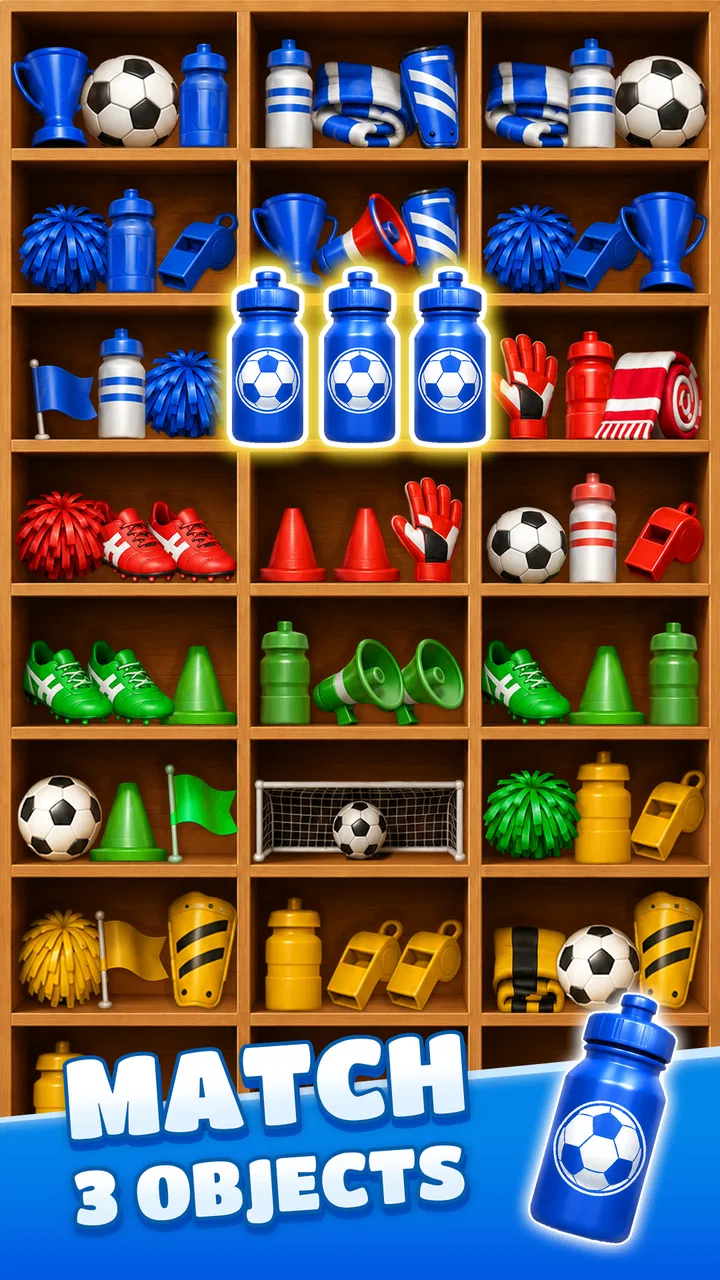
The central task is best understood as a visual organization problem. Objects are placed in a three-dimensional scene, and I look for matching pieces that can be brought together. The soccer flavor appears in the surrounding theme and gives the otherwise familiar sorting formula a more playful identity. You do not need to know soccer tactics or follow a sports storyline to enjoy it; the theme is decoration and atmosphere rather than a barrier to entry.
What makes the game pleasant at first is the direct relationship between an action and its result. I tap an item, place it with similar items, and watch the group move toward completion. That rhythm creates small moments of success without requiring a long commitment. It is a good fit for waiting rooms, short commutes, or the few minutes before bed when I want something active enough to hold my attention but not so demanding that it becomes tiring.
The three-dimensional presentation also changes how I read the board. In a flat match-three puzzle, the important information is usually arranged in a grid. Here, an object can be partly hidden by another object, and the order of removal matters. I found myself scanning the whole scene before making a move instead of tapping the first matching item I noticed. That extra visual step is where much of the game’s brain-training appeal comes from.
What happens when you start
For a first-time player, the most useful approach is to treat the opening stages as a tutorial in observation rather than rushing to clear everything immediately. I recommend looking for the most visible repeated objects first, then checking whether moving one of them exposes something useful underneath. This habit is more valuable than memorizing a particular sequence because the board encourages you to think about access and space.
The game’s free entry is important here. You can test whether the sorting loop fits your taste before deciding whether it deserves regular space on your phone. If you normally prefer word puzzles, crosswords, or traditional tile matching, the three-dimensional object handling may feel fresh. If you prefer fast action, precise timing, or a strong narrative, the pace may feel too measured.
One practical detail I appreciated is that the game does not demand specialist knowledge. The objects are meant to be identified visually, so the learning curve is mainly about understanding the board’s arrangement and the consequences of each choice. That makes it suitable for a broad age range, consistent with its Everyone content rating, though younger players may still benefit from guidance around optional purchases.
How to reach the first meaningful success
My advice for the opening attempt is simple: do not begin by collecting every object that looks similar from a distance. First, identify a complete or nearly complete group that is easy to reach. Clearing a visible group gives you a cleaner view of the scene, and that often reveals the next useful target. In other words, the first win is less about speed than about creating visibility.
A second helpful habit is to keep the available sorting area in mind. It is tempting to grab a matching object immediately because the action feels productive. However, placing several unrelated pieces in the same working space can make later decisions harder. I got better results when I treated open space as a resource and avoided filling it with objects whose partners were still buried or difficult to reach.
When I made a mistake, the problem was usually not that I failed to recognize a match. It was that I recognized one too early. A visible pair can be attractive, but if taking those pieces exposes a less useful arrangement, the immediate match may not be the best move. This is one of the game’s less obvious lessons: the strongest move is often the one that improves the next view of the board, not the one that produces the quickest animation.
That approach also makes the first successful session feel more understandable. Instead of seeing the game as random tapping, I began to see a sequence of small decisions: clear what is accessible, preserve room for future pieces, and use each removal to inspect what was hidden. Players who enjoy organizing shelves, matching objects, or solving visual layouts will probably recognize this satisfying pattern quickly.
Where new players can become confused
The three-dimensional style can make object recognition less immediate than it is in a flat puzzle. Similar shapes may appear at different angles, and a piece that seems available may be blocked by the arrangement around it. I found that rotating my attention around the scene, rather than staring at one corner, reduced mistakes. Even without overthinking every move, a full scan is worthwhile before committing to a group.
Another possible source of confusion is the difference between seeing a match and having a useful match. The game rewards planning around access, not simply spotting identical items. If a matching object is buried, clearing the visible layer may be more sensible than trying to force a group immediately. This can feel slower, but it gives you more control over the board.
The soccer theme may also lead some players to expect a sports game. That is not how I experienced it. The main activity remains object sorting and matching, so anyone installing it for football simulation, team management, or live competition may be disappointed. The sports identity works as a visual wrapper around a puzzle system; it does not replace that system.
There is also a difference between relaxing and becoming absorbed. Early boards are comfortable, but the sorting process can become mentally busy when several object types compete for attention. I would not describe every session as calming. Sometimes it is a pleasant distraction, and sometimes I found myself restarting my visual scan because I had filled the available space too carelessly. That mild pressure is part of the appeal, but it may bother players looking for a completely passive experience.
Making the most of later sessions
Once the basic interaction feels natural, I suggest adopting a three-pass routine. In the first pass, I inspect the scene and note the easiest groups. In the second, I remove only the pieces that improve visibility or create useful room. In the third, I reassess the board instead of following the original plan automatically. This matters because each successful removal changes what can be seen and what can be reached.
A less obvious benefit of this routine is that it limits impulsive play. The game’s visual feedback encourages quick actions, but quick actions are not always efficient. Pausing briefly between groups helped me notice objects that had been obscured and prevented me from committing space to a poor sequence. For a puzzle marketed as a brain exercise, that pause-and-reassess habit is more meaningful than simply trying to finish faster.
I also recommend separating recognition from execution. First decide which group you want to work on; then move the pieces deliberately. Mixing those two steps can lead to accidental clutter because you keep changing targets while the board is already becoming more complex. This is especially useful for players using a smaller phone screen, where visual scanning may take longer.
If you are playing during a short break, choose a stopping point before beginning. The loop is built from small completions, so it is easy to continue after one successful group. That is enjoyable when you have time, but less convenient when you only intended to play briefly. A short session works best when you focus on one clear objective, such as learning the object layout or practicing more careful space management.
How it compares with other puzzle choices
Compared with classic match-three games, this title feels less dependent on rapid combinations and more dependent on spatial reading. Traditional match-three play often asks me to search a grid for a swap that creates a chain. Here, I am managing physical-looking objects and their order of access. Players who like predictable rows and columns may find this less immediately transparent, while players who enjoy clutter-clearing puzzles may prefer the added depth.
Compared with hidden-object games, it is more structured. I am not simply searching for unrelated items in a picture; I am trying to form useful groups and manage the consequences of removing them. That makes the experience more strategic than a basic visual hunt, even though careful looking remains essential.
Compared with word puzzles, it asks for less language and more visual memory. This makes it a better choice when I want a puzzle that works without reading long prompts or recalling vocabulary. On the other hand, someone seeking a deep logical system, rich clues, or a sense of solving a single elaborate problem may find the repeated sorting loop too narrow.
Its strongest position is between relaxation and light strategy. It is more involving than a decorative idle game, but less demanding than a serious competitive puzzle title. That middle ground explains why it can appeal to casual players while still giving experienced puzzle fans something to think about once the obvious matches stop being enough.
Who should install it, and who should skip it
I would recommend it to players who enjoy organizing visual spaces, matching objects, and making careful choices in short sessions. It is particularly suitable if you want a game that starts gently, uses familiar interactions, and gradually rewards better scanning. The broad age rating and free entry also make it easy to try on a shared family device, provided adults keep an eye on optional purchases.
I would be more cautious if you need a game with a strong narrative, a large variety of mechanics, or direct multiplayer competition. The soccer presentation will not provide those things by itself. I would also skip it if repetitive sorting quickly loses your interest, because the core activity remains consistent even when the board becomes more demanding.
Players who are sensitive to monetization should approach the free model thoughtfully. The title can be sampled without an upfront price, but optional items cost between $1.99 and $79.99 each. I recommend deciding in advance whether you are only testing the free experience or whether you are comfortable considering purchases later. That simple boundary makes the game easier to enjoy without turning every obstacle into a spending decision.
My practical verdict after settling into the loop
Goods 3D Sorting: Match Games works because it turns an ordinary organizing task into a sequence of small visual decisions. Pleasure City has chosen a familiar puzzle foundation and given it a three-dimensional object focus, with soccer styling that helps it stand apart without changing what you actually do. The result is approachable, but it still rewards patience once the board becomes crowded.
The game’s best quality is the way it teaches useful habits without announcing them: scan before acting, protect working space, and value future access over an immediate match. Those lessons make the experience feel more substantial than a simple tap-to-clear pastime. They are also the reason I would suggest playing with intention rather than rushing through every available object.
My reservations are equally clear. The format can become repetitive, the three-dimensional arrangement may occasionally make recognition harder, and the sports theme could mislead anyone expecting a conventional soccer game. Optional purchases also mean that the free label should be understood as an invitation to try, not a promise that every part of the experience is entirely free of commercial pressure.
Still, for a first-time user, the path is friendly: install it on a compatible device, learn to identify accessible groups, clear the board in a way that opens new views, and then start planning around space. With more than ten million installs and a 4.9 average from roughly 281 thousand ratings, it has clearly found a substantial audience. I think that audience is most likely to include people who want a colorful, low-barrier puzzle with enough spatial thinking to keep a short break interesting.
After trying the basic loop, my recommendation is to give it a fair session rather than judging it from the opening taps alone. The first success shows you how matching works; the next step is learning why one match is better than another. If that gradual shift from recognition to planning sounds enjoyable, this free puzzle game is worth keeping around. If you want stories, action, or a genuinely soccer-focused experience, another category will serve you better.
FAQs for Goods 3D Sorting: Match Games
01What is Goods 3D Sorting: Match Games?
Goods 3D Sorting: Match Games is a casual puzzle game focused on organizing colorful products in a three-dimensional store-like environment. Your objective is to sort matching items, usually placing three identical goods together to clear them from the shelves. The game combines simple matching mechanics with increasingly challenging layouts, making it easy to learn but progressively more demanding as new levels introduce limited space, obstacles, and time pressure.
02How do you play Goods 3D Sorting: Match Games?
Gameplay is based on selecting products and arranging them into the available trays or shelves until three matching items are grouped together. Completed matches disappear, creating room for additional goods. Before moving an item, it is important to look at the entire arrangement because choosing the wrong product can block useful spaces. Later stages require planning, careful sequencing, and occasional use of boosters when the board becomes difficult to manage.
03Is Goods 3D Sorting: Match Games free to download and play?
Goods 3D Sorting: Match Games can generally be downloaded and played for free, although the experience may include optional in-app purchases. These purchases can provide coins, boosters, extra moves, or other advantages, but they are not always required to enjoy the main levels. Players should also expect advertising between stages or after certain actions, depending on the version and device settings.
04Does Goods 3D Sorting: Match Games require an internet connection?
The basic sorting and matching levels may work without a constant internet connection, which is convenient for playing while traveling or when mobile data is unavailable. However, some features may depend on connectivity, including advertisements, cloud progress, special events, purchases, and updates. For the most complete experience, it is recommended to connect to the internet occasionally and keep the game updated.
05Is Goods 3D Sorting: Match Games suitable for children and casual players?
The game is suitable for casual players who enjoy relaxing sorting, matching, and organization puzzles. Its controls are straightforward, so beginners can understand the mechanics quickly, while later levels provide more challenge for experienced players. Parents should still review the app-store age rating and advertising or purchase settings, particularly if children will play, because optional transactions and promotional content may be available.
Pros
- Relaxing gameplay suitable for short breaks or casual sessions.
- Clear 3D visuals make most objects easy to recognize and match.
- Increasing difficulty keeps later levels more engaging.
- Simple tap controls are accessible for players of all ages.
- Offline play makes it convenient when no internet connection is available.
Cons
- Some levels can feel repetitive after extended play sessions.
- Later puzzles may rely more on patience than strategic thinking.
- Hints and boosters may be limited without watching ads or spending currency.
- Small objects can occasionally be difficult to select accurately.
- Frequent advertisements may interrupt the flow between levels.

Goods 3D Sorting: Match Games
Gallery